Self sabotage happens when you get in your own way right before progress, change, success, closeness, or peace. You may want something badly, but then you delay it, avoid it, ruin it, overthink it, push people away, quit too early, or make choices that pull you back into old patterns.
Self sabotage is not always obvious. Sometimes it looks like procrastination. Sometimes it looks like perfectionism. Sometimes it looks like picking a fight, ghosting someone, spending money you planned to save, staying up too late before an important day, or giving up when things finally start working.
Learning how to stop self sabotage before it starts means catching the pattern early. You do not wait until the damage is done. You learn your warning signs, challenge the fear behind the behavior, and choose the next right action before your old habits take over.
- What Is Self Sabotage?
- Signs You Are Self Sabotaging
- Why Self Sabotage Happens
- The First Sign Self Sabotage Is Starting
- How to Stop Self Sabotage Before It Starts
- What to Do in the Moment You Want to Sabotage Yourself
- What Not to Do When You Notice Self Sabotage
- When Self Sabotage Is Connected to Childhood
- Final Thoughts
What Is Self Sabotage?
Self sabotage is when your actions work against your own goals, needs, values, or wellbeing.
It can happen even when you truly want to change.
You may want a healthy relationship, but you push someone away.
You may want better health, but you keep ignoring your basic needs.
You may want to finish a project, but you keep delaying the first step.
You may want peace, but you keep returning to drama.
You may want confidence, but you keep speaking to yourself like you are already failing.
Self sabotage is often a protection habit. A part of you is trying to avoid fear, rejection, failure, shame, responsibility, or the unknown. The problem is that the protection creates a new problem.
Signs You Are Self Sabotaging
You may be self sabotaging if you notice patterns like these:
- You delay things that matter to you.
- You quit when progress starts showing.
- You start strong but struggle to finish.
- You avoid opportunities because you fear failing.
- You overthink until you do nothing.
- You talk yourself out of good things.
- You create problems when life feels calm.
- You push people away when they get close.
- You choose familiar pain over unfamiliar growth.
- You ignore your own boundaries.
- You make impulsive choices after stress.
- You wait until everything feels perfect before starting.
- You tell yourself you are not ready, even when you are capable.
- You assume something will go wrong before it happens.
- You downplay your progress.
- You compare yourself until you lose motivation.
- You punish yourself after small mistakes.
- You avoid asking for help.
- You return to habits you know hurt you.
- You keep choosing short-term relief over long-term peace.
Why Self Sabotage Happens
Self sabotage usually has a reason behind it. The reason may not be logical, but it makes emotional sense.
- You may sabotage yourself because success feels unfamiliar.
- You may sabotage yourself because failure feels safer than trying fully.
- You may sabotage yourself because you learned not to expect good things.
- You may sabotage yourself because you fear being judged.
- You may sabotage yourself because you do not trust yourself to handle change.
- You may sabotage yourself because part of you believes you do not deserve better.
Self sabotage is often rooted in fear, not laziness.
But fear does not need to make the decision for you.
The First Sign Self Sabotage Is Starting
Self sabotage usually begins before the behavior.
It often starts with a thought.
Examples:
- “What if I fail?”
- “I’ll do it later.”
- “This is too hard.”
- “I always mess things up.”
- “They will reject me anyway.”
- “There is no point trying.”
- “I’m not ready.”
- “I don’t deserve this.”
- “This will probably go badly.”
Once that thought appears, your behavior may start shifting.
You delay.
You avoid.
You withdraw.
You distract yourself.
You start a conflict.
You stop trying.
To stop self sabotage before it starts, you need to catch the thought before it becomes an action.
How to Stop Self Sabotage Before It Starts
Step 1: Name the Pattern Early
The first step is to call the pattern what it is.
Do not wait until you have ruined the opportunity, avoided the conversation, missed the deadline, or pushed the person away.
Catch it early and say:
“This is self sabotage starting.”
“This is my old pattern.”
“This is fear trying to lead.”
“This is the moment where I usually quit.”
Naming the pattern gives you power over it.
When you do not name it, it feels like truth.
When you name it, it becomes something you can challenge.
Step 2: Identify Your Self Sabotage Triggers
Self sabotage often happens around specific triggers.
A trigger is the situation that wakes up the old pattern.
Common triggers include:
Success
Rejection
Conflict
Closeness
Big decisions
Praise
Pressure
Change
Being seen
Having responsibility
Feeling uncertain
Starting something new
Receiving criticism
Being compared to others
Getting close to a goal
Ask yourself:
“When do I usually sabotage myself?”
“What happens right before I shut down, avoid, quit, or act impulsively?”
“What situations make me want to run from progress?”
Once you know your triggers, you can prepare for them instead of being controlled by them.
Step 3: Learn Your Personal Warning Signs
Self sabotage has early warning signs.
You may notice changes in your thoughts, mood, behavior, or choices.
Examples:
You suddenly feel tired when it is time to act.
You start scrolling instead of doing the task.
You keep rewriting the plan instead of starting.
You feel the urge to cancel.
You become overly critical of yourself.
You pick apart a good opportunity.
You imagine the worst possible outcome.
You feel irritated at people who support you.
You start comparing yourself to others.
You convince yourself the goal does not matter anymore.
You feel tempted to do the opposite of what helps you.
Write down your top warning signs.
The more clearly you know them, the faster you can interrupt them.
Step 4: Ask, “What Am I Trying to Avoid?”
Self sabotage usually helps you avoid something in the short term.
Ask yourself:
“What feeling am I trying not to feel?”
“What outcome am I trying to prevent?”
“What am I afraid will happen if I keep going?”
“What feels unsafe about success, change, or progress?”
You may be trying to avoid:
Failure
Shame
Judgment
Disappointment
Responsibility
Pressure
Conflict
Rejection
Being seen
Being vulnerable
Making the wrong choice
Once you know what you are avoiding, you can deal with the real fear instead of attacking yourself.
Step 5: Challenge the Thought Before You Follow It
Self sabotage often comes with convincing thoughts.
Do not believe every thought just because it feels strong.
Challenge it.
If your thought says:
“I will fail.”
Ask:
“What proof do I actually have?”
“What proof do I have that I can handle this?”
“What would I tell someone else in my position?”
If your thought says:
“I’m not ready.”
Ask:
“What part of this can I do now?”
“Am I truly not ready, or am I uncomfortable?”
“What would readiness look like in real life?”
If your thought says:
“There is no point.”
Ask:
“What will happen if I keep repeating this pattern?”
“What small result could still matter?”
“What is the cost of giving up again?”
Your thoughts do not need to disappear before you act.
You can act while challenging them.
Step 6: Separate Fear From Fact
Fear often speaks like a fact.
It says:
“This will go wrong.”
“They will leave.”
“You cannot handle this.”
“You will embarrass yourself.”
“You always fail.”
But fear is not proof.
A better question is:
“Is this a fact, or is this fear?”
A fact is something you can prove.
Fear is something you imagine might happen.
For example:
Fear says: “Everyone will judge me.”
Fact says: “I do not know how everyone will respond.”
Fear says: “I always ruin everything.”
Fact says: “I have struggled before, but I have also kept going before.”
Fear says: “If I make one mistake, it is over.”
Fact says: “Most mistakes can be corrected.”
This helps you stop treating fear like an instruction.
Step 7: Choose the Smallest Next Right Action
Self sabotage grows when the next step feels too big.
Do not ask yourself to fix your whole life in one moment.
Ask:
“What is the smallest next right action?”
Examples:
Open the document.
Send the message.
Put the phone away for ten minutes.
Write the first sentence.
Make the appointment.
Take a short walk.
Pay one bill.
Clean one small area.
Reply honestly.
Apologize without overexplaining.
Ask one direct question.
Say no once.
Start for five minutes.
The goal is movement.
Small action breaks the spell of avoidance.
Step 8: Use a Pause Before Impulsive Choices
Self sabotage often happens fast.
You send the angry text.
You cancel the plan.
You spend the money.
You quit the project.
You push someone away.
You eat, scroll, shop, or distract yourself before thinking.
Build a pause.
Tell yourself:
“I do not have to act on this urge right now.”
“I can wait ten minutes before deciding.”
“I can choose after I calm down.”
“This urge is strong, but it is not in charge.”
A pause gives your better judgment time to catch up.
Step 9: Stop Making Decisions From Shame
Shame is one of the biggest drivers of self sabotage.
When you feel ashamed, you may think:
“I already messed up, so why try?”
“I am a failure.”
“I might as well give up.”
“I do not deserve better.”
This is how one mistake turns into a full setback.
Instead, say:
“I made a mistake, but I can still choose the next right action.”
“This moment does not define me.”
“I do not need to punish myself to improve.”
“I can correct this without attacking myself.”
Shame keeps you stuck.
Accountability helps you move.
Step 10: Replace All-or-Nothing Thinking
Self sabotage loves all-or-nothing thinking.
Examples:
“If I cannot do it perfectly, I should not do it.”
“If I missed one day, I failed.”
“If they are upset with me, the relationship is over.”
“If I made one mistake, I ruined everything.”
“If I am scared, I should stop.”
Challenge this thinking.
Replace it with:
“Something is better than nothing.”
“One mistake is not the whole story.”
“I can repair instead of quit.”
“I can continue imperfectly.”
“I do not need to feel confident to keep going.”
Progress usually happens through imperfect action.
Step 11: Stop Waiting to Feel Motivated
Many people sabotage themselves by waiting for motivation.
They say:
“I’ll start when I feel ready.”
“I’ll do it when I feel confident.”
“I’ll change when I feel inspired.”
But motivation often comes after action, not before it.
Start before you feel ready.
Do the small step.
Build proof through action.
Confidence grows when you keep promises to yourself.
Step 12: Make Your Environment Harder to Sabotage
Do not rely only on willpower.
Change your environment so the better choice is easier.
Examples:
Put your phone in another room while working.
Keep your workspace clear.
Prepare what you need the night before.
Remove apps that keep pulling you into avoidance.
Keep helpful items visible.
Block distracting websites during work time.
Set reminders for important tasks.
Keep your calendar simple.
Place your walking shoes near the door.
Write your top goal where you can see it.
Your environment should support the person you are trying to become.
Step 13: Create a Self Sabotage Plan Before You Need It
Do not wait until you are in the middle of the pattern.
Make a plan now.
Write this down:
“When I notice myself avoiding, I will take one small action.”
“When I want to quit, I will pause for ten minutes first.”
“When I feel ashamed, I will correct the mistake instead of attacking myself.”
“When I want to push someone away, I will explain what I need instead.”
“When I start overthinking, I will write the facts and choose one step.”
“When I feel the urge to ruin progress, I will ask what I am afraid of.”
A plan helps you act differently when your old pattern tries to take over.
Step 14: Watch for the “I Don’t Care” Trap
A common sign of self sabotage is suddenly convincing yourself you do not care.
You may say:
“I do not even want this anymore.”
“This goal is stupid.”
“It does not matter.”
“I’m done.”
“I do not care what happens.”
Sometimes this is true.
But sometimes it is fear pretending to be indifference.
Ask yourself:
“Do I truly not care, or am I scared to keep trying?”
“Would I still want this if I knew I could handle the discomfort?”
“Am I quitting because this is wrong for me, or because it matters?”
This question can stop you from walking away from something important.
Step 15: Stop Testing People by Pushing Them Away
In relationships, self sabotage often looks like testing people.
You may:
Withdraw to see if they chase you.
Start conflict to see if they stay.
Act cold when you need reassurance.
Reject help before it is offered.
Assume they will leave, then behave in ways that create distance.
This often comes from fear of abandonment or fear of being hurt.
A healthier response is direct communication.
Instead of pushing someone away, say:
“I’m feeling unsure and I need clarity.”
“I’m scared I misunderstood you.”
“I need reassurance, but I am trying not to act from fear.”
“I want to talk instead of shutting down.”
Healthy relationships need honesty, not emotional tests.
Step 16: Keep Promises to Yourself
Self sabotage weakens self-trust.
Every time you say you will do something and do not follow through, your trust in yourself drops.
Rebuild it with small promises.
Examples:
“I will work on this for ten minutes.”
“I will go to bed at the time I chose.”
“I will reply to that message today.”
“I will take one walk.”
“I will not send that angry text.”
“I will finish one small task.”
Keep the promise small enough that you can actually do it.
Small kept promises create real self-trust.
Step 17: Stop Confusing Safety With Familiarity
Sometimes people return to harmful patterns because they feel familiar.
Familiar does not always mean safe.
Avoidance may feel familiar.
Chaos may feel familiar.
Self-criticism may feel familiar.
Unhealthy relationships may feel familiar.
Quitting may feel familiar.
But familiar pain is still pain.
Ask yourself:
“Am I choosing this because it is good for me, or because it is what I know?”
Growth often feels strange at first.
That does not mean it is wrong.
Step 18: Prepare for Success, Not Just Failure
Many people only plan for what to do if they fail.
But success can also feel uncomfortable.
You may sabotage yourself when things start going well because you are not used to it.
Ask yourself:
“What will I do when this starts working?”
“What support will I need when I make progress?”
“How will I handle praise, attention, or responsibility?”
“What will I do if life becomes calmer?”
Success requires a new identity.
You must learn how to stay with good things instead of running from them.
Step 19: Stop Using Perfectionism as Protection
Perfectionism often looks responsible, but it can be a form of self sabotage.
It keeps you stuck in preparation mode.
You keep editing.
You keep researching.
You keep planning.
You keep waiting.
You never release, ask, apply, post, start, or finish.
Tell yourself:
“Done is better than abandoned.”
“Imperfect progress still counts.”
“I can improve after I begin.”
“I do not need to be flawless to move forward.”
Perfectionism promises safety, but it often steals progress.
Step 20: Build Proof That You Can Handle Discomfort
Self sabotage often says:
“You cannot handle this.”
Prove otherwise through action.
Do one thing that feels uncomfortable but helpful.
Examples:
Have the honest conversation.
Start the task.
Set the boundary.
Ask the question.
Show your work.
Apply for the opportunity.
Let someone support you.
Try again after a mistake.
Each time you do something uncomfortable and survive it, your fear loses power.
Step 21: Review the Pattern After It Happens
You will not catch self sabotage perfectly every time.
When it happens, do not spiral into shame.
Review it.
Ask:
“What triggered me?”
“What thought showed up first?”
“What feeling was I trying to avoid?”
“What did I do?”
“What did it cost me?”
“What can I do differently next time?”
This turns the setback into information.
You are not starting over.
You are learning the pattern more clearly.
Step 22: Choose Repair Over Collapse
A key part of stopping self sabotage is learning how to recover quickly.
One bad moment does not need to become a bad week.
One missed task does not need to become giving up.
One difficult conversation does not need to destroy a relationship.
One mistake does not need to become your identity.
Ask:
“What can I repair right now?”
“What is still possible?”
“What is the next honest step?”
Repair keeps you moving.
Collapse keeps you stuck.
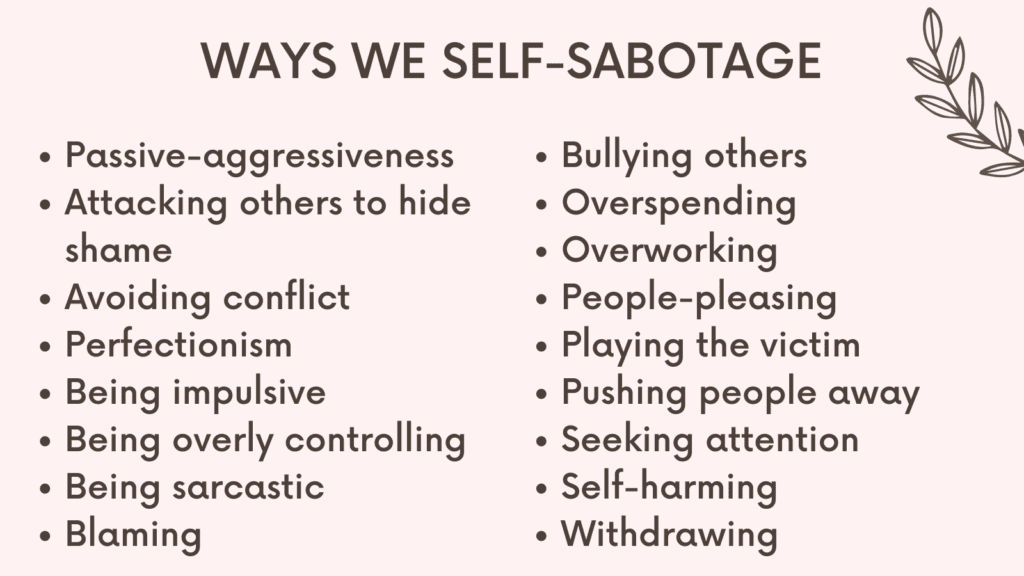
Common Types of Self Sabotage
Self sabotage can show up in many forms.
Procrastination
You delay important tasks until they become stressful or impossible.
Perfectionism
You avoid starting or finishing because the result may not be perfect.
Overthinking
You think so much that you never act.
Avoidance
You ignore problems and hope they disappear.
Impulsive Choices
You make quick decisions that hurt your long-term goals.
Pushing People Away
You create distance when relationships start feeling close.
Negative Self-Talk
You speak to yourself in a way that destroys motivation.
Quitting Too Early
You stop before your effort has enough time to work.
Creating Drama
You create conflict when calm feels unfamiliar.
Choosing the Wrong People
You keep returning to relationships that repeat old pain.
How to Stop Self Sabotage in Relationships
Relationship self sabotage often happens when closeness feels risky.
You may assume people will hurt you, leave you, judge you, or disappoint you.
So you try to protect yourself first.
You may withdraw.
You may become defensive.
You may start arguments.
You may test people.
You may accuse before asking.
You may end things before they can end them.
To stop this pattern, practice direct communication.
Say what you mean earlier.
Ask before assuming.
Tell the truth without attacking.
Notice when fear is writing the story.
Choose repair instead of punishment.
A helpful question is:
“Am I responding to this person, or am I responding to an old fear?”
How to Stop Self Sabotage at Work
Workplace self sabotage often shows up as procrastination, overthinking, perfectionism, or avoiding visibility.
You may avoid applying for roles.
You may downplay your skills.
You may wait until the last minute.
You may avoid asking questions.
You may not speak up because you fear looking foolish.
To stop this pattern, focus on action over feeling ready.
Break tasks into small steps.
Submit work when it is good enough.
Ask for clarity instead of guessing.
Track your progress so your brain cannot dismiss it.
Speak up once, even if your voice shakes.
Work confidence grows through repeated action.
How to Stop Self Sabotage With Goals
Goal self sabotage often starts when the goal becomes real.
At first, it feels exciting.
Then it starts requiring effort, discipline, change, and patience.
That is when the old pattern appears.
To stop it, make your goal harder to abandon.
Write your reason clearly.
Choose a small daily action.
Track completion, not perfection.
Plan for bad days.
Remove obvious distractions.
Tell one safe person.
Review progress weekly.
Do not rebuild the whole plan every time your mood changes.
Stay with the goal long enough for results to appear.
How to Stop Self Sabotage With Money
Money self sabotage can look like spending after stress, ignoring bills, avoiding your bank account, undercharging, or feeling guilty for wanting financial stability.
To stop this pattern, start with awareness.
Look at the numbers without attacking yourself.
Choose one money action at a time.
Cancel one unnecessary expense.
Set one payment reminder.
Create one simple savings rule.
Wait 24 hours before unplanned purchases.
Ask:
“Is this purchase helping my future self or rescuing my current mood?”
Money habits improve when you stop avoiding the truth.
How to Stop Self Sabotage With Health
Health self sabotage often happens when people aim too high too fast.
They try to change everything, then feel like a failure when they cannot maintain it.
Start smaller.
Walk for ten minutes.
Drink water before another drink.
Prepare one simple meal.
Go to bed a little earlier.
Keep basic routines realistic.
Do not use one imperfect day as proof that you failed.
Health improves through repeated basic choices, not extreme plans you cannot keep.
Self Sabotage Questions to Ask Yourself
Use these questions when you feel the pattern starting:
“What am I about to do that may hurt my progress?”
“What am I afraid will happen if I keep going?”
“What old belief is showing up right now?”
“Am I choosing based on fear or facts?”
“What is the smallest helpful action I can take?”
“What would my future self want me to do?”
“What will this choice cost me tomorrow?”
“What am I trying to escape?”
“Is this familiar, or is it actually good for me?”
“How can I repair this before it becomes bigger?”
Self Sabotage Statements to Challenge
When self sabotage starts, challenge the thought directly.
“I always fail.”
Change it to:
“I have failed before, but I have also learned before.”
“I’m not ready.”
Change it to:
“I can start with the part I know.”
“There is no point.”
Change it to:
“There is a point in taking one step.”
“I already ruined it.”
Change it to:
“I can still repair part of this.”
“I cannot handle this.”
Change it to:
“I can handle the next five minutes.”
“They will reject me.”
Change it to:
“I do not know that yet. I can ask instead of assume.”
“If it is not perfect, it is worthless.”
Change it to:
“Imperfect work can still be useful.”
What to Do in the Moment You Want to Sabotage Yourself
Use this simple process:
Name it: “This is self sabotage starting.”
Pause: “I do not need to act immediately.”
Question it: “What am I afraid of?”
Challenge it: “Is this fear or fact?”
Choose: “What is the smallest helpful action?”
Move: “Do that action now.”
This process works because it interrupts the automatic pattern.
You are teaching yourself that urges are not commands.
What Not to Do When You Notice Self Sabotage
Do not attack yourself.
Do not say, “I am broken.”
Do not use shame as motivation.
Do not wait until you feel confident.
Do not make the plan too complicated.
Do not expect perfection.
Do not turn one bad choice into a full collapse.
Do not confuse discomfort with danger.
Do not ask everyone for reassurance before acting.
Do not quit just because your fear got loud.
The goal is not to never feel fear.
The goal is to stop letting fear make every decision.
When Self Sabotage Is Connected to Childhood
Many self sabotage patterns begin in childhood.
If you grew up with criticism, rejection, emotional neglect, chaos, pressure, or unpredictable care, you may have learned certain beliefs.
You may have learned:
“I am not good enough.”
“Good things do not last.”
“I must not make mistakes.”
“I have to stay small.”
“My needs cause problems.”
“People leave.”
“I should not trust success.”
These beliefs can follow you into adulthood.
But they can be challenged.
You can learn new beliefs through repeated action.
You can prove to yourself that you are capable, worthy, and allowed to build a better life.
When to Get Extra Support
Sometimes self sabotage is hard to change alone, especially when it is connected to trauma, deep shame, addiction, unsafe relationships, or long-term emotional pain.
Extra support may help if:
You keep repeating the same pattern despite trying to stop.
You feel unable to control impulsive choices.
You sabotage relationships you deeply care about.
You feel intense shame after mistakes.
You avoid important parts of life.
You keep returning to harmful habits.
You feel stuck in old childhood wounds.
A therapist, counselor, coach, or trusted support person can help you understand the pattern and practice new responses.
Getting support is not weakness.
It is a practical step toward change.
Final Thoughts
Learning how to stop self sabotage before it starts means catching the pattern early, naming the fear, challenging the thought, and choosing one helpful action before the old habit takes over.
You do not need to wait until you feel confident.
You do not need to fix everything at once.
You do not need to become perfect.
You need to notice the moment where you usually avoid, quit, hide, push away, or act against yourself, and choose differently.
Every time you pause instead of react, act instead of avoid, repair instead of collapse, and challenge fear instead of obeying it, you weaken self sabotage.
The more you keep showing up for yourself, the less power the old pattern has.