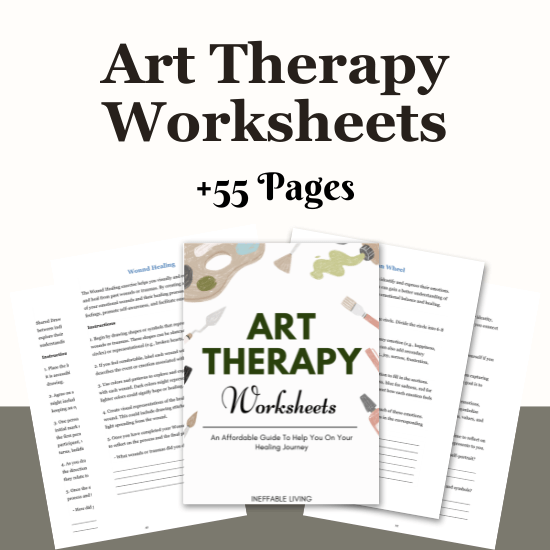
Art therapy uses creative activities to help you explore thoughts, emotions, and experiences that may be difficult to put into words. It can include drawing, painting, collage, coloring, working with clay, or using shapes, colors, patterns, and symbols.
You do not need to be artistic or good at drawing. The goal is not to create beautiful artwork. The focus is on what comes up while you create and what the finished image or object may help you notice.
How Does Art Therapy Work?
Art can make thoughts and emotions easier to see. For example, you might use different colors to represent emotions, create an abstract picture of stress, or make a collage showing what you want more of in your life.
Afterward, you can look at what you created and ask questions such as:
- What stands out to me?
- What emotion does this represent?
- What does this show me about my current situation?
- Is there anything I want to change in the picture?
- What could I do differently in real life?
Art Therapy Journal Prompts
- Fill a page with colors that represent how today felt. Afterward, write about which color took up the most space and why.
- Draw two boxes: one for things within your control and another for things outside your control. Fill each with words, symbols, colors, or patterns.
- Draw a container and fill it with words or symbols representing everything currently taking up mental space. Write about which things need attention and which can wait.
- Draw several empty jars or containers and label them with things that use your emotional energy. Shade each one according to how full it currently feels.
- Draw a road with several turns representing a difficult decision. Label the different directions with possible choices and what each might lead toward.
- Create an abstract image of an emotion you have difficulty naming. Do not try to make it attractive. Let the color, pressure, lines, and texture represent the feeling.
- Draw several circles of different sizes representing the problems currently demanding your attention. Make each circle proportional to how important the problem actually is rather than how loud it feels.
- Draw a suitcase and fill it with beliefs, expectations, responsibilities, or worries you have been carrying. Circle anything you may no longer need to carry.
- Draw a bridge between two sides of a page. Label one side “Where things are now” and the other “Where I want them to be.” Add practical steps along the bridge.
- Draw several layers of shapes on top of one another. Let the outer layers represent obvious emotions and the deeper layers represent what may be underneath them.
- Draw an empty room and fill it with objects, colors, and textures that would make the space feel peaceful. Write about what those choices reveal about what you currently need.
- Draw a collection of boxes representing unfinished tasks, unresolved problems, or unanswered questions. Mark which ones actually require action now.
- Draw a staircase. On each step, write one small action that could move you toward something you want.
- Draw several doors representing choices currently available to you. Label each door with what you know about that option rather than what you fear might happen.
- Create a page titled “Things That Are Going Better Than I Notice” and represent each one with a small symbol, shape, color block, or object.
- Draw an anchor as an object and surround it with words representing routines, beliefs, places, resources, and activities that help create stability.
- Draw a series of traffic lights. In the red section, write behaviors you want to stop when emotions are intense. In yellow, write warning signs. In green, write responses you want to practice.
- Draw a scale and place the demands currently placed on you on one side and the resources available to handle them on the other. Write about what would create better balance.
- Create a page of repeated patterns representing thoughts that keep returning. Interrupt some of the patterns with new shapes or colors representing alternative thoughts.
- Draw an empty shelf and place symbolic objects on it representing priorities you want to make more room for.
- Create a picture representing “what I expected” beside one representing “what actually happened.” Write about the difference between disappointment and catastrophe.
- Draw several empty envelopes and write something you wish could be expressed inside each one. The messages do not need to be sent.
- Draw a series of windows. Inside each window, represent a different way of looking at the same situation.
- Create an image of a heavy object and write the worries, responsibilities, or expectations making it feel heavy. Then identify what could realistically be removed.
What Can Art Therapy Help With?
Art therapy may be used to explore stress, anxiety, grief, trauma, anger, low self-esteem, relationship difficulties, and major life changes. It can also help you identify emotions, understand patterns, and find new ways of looking at a problem.