This post contains anxiety journaling prompts to help you manage your difficult emotions.
What Are Journaling Prompts?
Journal prompts are a tool for self-reflection and self-discovery.
They are suggestive prompts designed with the intention of sparking introspection.
This is a great way to relieve emotional distress and connect more deeply with yourself.
Related: Top 10 Practical CBT Exercises For Generalized Anxiety Disorder Relief
The Benefits of Journaling
A growing number of studies show that journaling can be a great way to reduce mental stress and anxiety.
Journaling can help you:
- Identify what triggers your anxiety
- Figure out healthier ways to deal with those triggers
- Reduce anxious thoughts and feelings
- Challenge negative thoughts and self-talk
- Face your fears
- Boost your mood
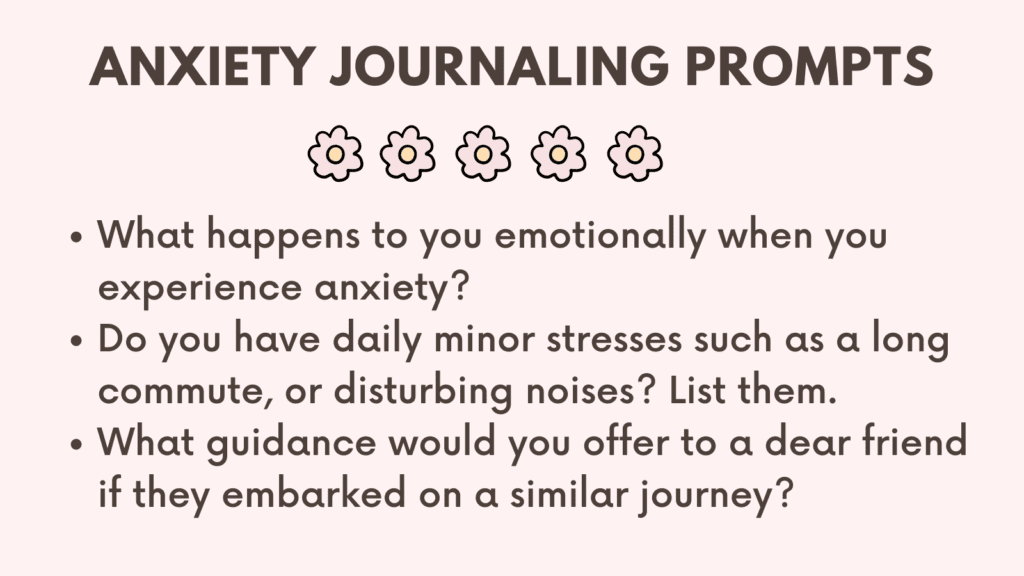
Anxiety Journaling Prompts
- What is making you anxious right now?
- When did this anxiety start today?
- What was happening just before it showed up?
- What thoughts are driving the anxiety?
- What are you predicting will go wrong?
- What is the worst outcome you are imagining?
- How likely is that outcome really?
- What evidence supports this fear?
- What evidence goes against it?
- What part of this situation is out of your control?
- What part is within your control?
- What are you trying to prevent or avoid?
- What does anxiety want you to do right now?
- What happens if you don’t obey it?
- What has anxiety cost you recently?
- What has it not protected you from?
- What reassurance are you seeking?
- How long does reassurance usually last?
- What keeps the anxiety cycle going?
- What pattern do you notice in your anxiety?
- What does anxiety feel like in your body?
- Where do you feel it the most?
- What sensations tell you anxiety is rising?
- What do you do when those sensations appear?
- What behaviors calm anxiety short term?
- What behaviors make it worse later?
- What do you overcheck, overthink, or overanalyze?
- What do you avoid because of anxiety?
- What has avoidance cost you?
- What would happen if you faced it gradually?
- What fears keep repeating in your life?
- What past experiences fuel these fears?
- What are you afraid this anxiety says about you?
- What does it actually say about your needs?
- What emotions sit underneath your anxiety?
- What are you afraid to feel fully?
- What does anxiety distract you from feeling?
- What does anxiety distract you from doing?
- What do you lose when anxiety is in charge?
- What do you gain when you challenge it?
- What thoughts feel urgent but aren’t helpful?
- What thoughts feel calmer and more realistic?
- What would a balanced thought sound like here?
- What would you tell someone else in this situation?
- Why is it harder to say that to yourself?
- What are you assuming without proof?
- What facts do you actually know?
- What questions could slow your thinking down?
- What thought do you need to challenge today?
- What thought do you need to replace it with?
- What situations trigger your anxiety most often?
- What people trigger it most?
- What environments make it worse?
- What environments help it ease?
- What time of day is anxiety strongest for you?
- What habits increase anxiety?
- What habits reduce it over time?
- What boundaries would lower your anxiety?
- What boundaries are you avoiding setting?
- What fear stops you from setting them?
- What control are you trying to maintain?
- What happens when you try to control everything?
- What happens when you don’t?
- What uncertainty feels hardest to tolerate?
- What uncertainty have you survived before?
- What does anxiety say will happen if you relax?
- Has that ever actually happened?
- What does calm feel unfamiliar about?
- What does safety mean to you?
- What actually creates safety for you long term?
- What reassurance do you give others easily?
- What reassurance do you deny yourself?
- What does self-trust look like during anxiety?
- What proof do you have that you can cope?
- What has anxiety convinced you you can’t handle?
- What have you already handled despite anxiety?
- What small step could you take while anxious?
- What would progress look like without anxiety disappearing?
- What does courage look like for you today?
- What would choosing action over fear look like here?
- What does anxiety want you to believe about the future?
- How realistic is that belief?
- What happens if you stop rehearsing worst-case scenarios?
- What do you gain by staying alert all the time?
- What do you lose?
- What are you exhausted from worrying about?
- What worry has never actually come true?
- What would letting go of that worry change?
- What do you want anxiety to have less control over?
- What do you want more control over instead?
- What helps anxiety pass naturally over time?
- What makes you panic faster?
- What warning signs tell you anxiety is escalating?
- What can you do earlier next time?
- What does responding instead of reacting look like?
- What does strength look like when anxiety is present?
- What does patience with yourself look like here?
- What do you want to remember during your next anxious moment?
- What is one thing anxiety cannot decide for you?
- What would living alongside anxiety, not under it, look like?
FREE Anxiety Worksheets PDF
Related: How To Overcome Agoraphobia Without Medication? 9-Step Guide To Control Panic Attack In Public
Best Journaling Apps
To journal, you can use physical notebook or papers or an audio journal where you speak into a recording device or you can also use a digital journal.
The following are some of the best journaling apps:
- Day One for Mac and iOS users
- Daylio for iOS & Android users
- Diarium for Windows, macOS, iOS & Android users
- Grid Diary for macOS, iOS & Android users
- Momento for social media power users
- Penzu for Windows, macOS, iOS & Android users
Related: 30 Day Social Anxiety Challenge That Will Help You Feel More Confident
How to Use Anxiety Journaling Prompts?
Here are some tips on how to use anxiety journaling prompts:
1. Set aside time: Schedule some quiet time for yourself where you can focus on your writing without any distractions or interruptions.
2. Choose a prompt: Pick a prompt that resonates with you or feels most relevant to your current situation.
3. Allow free-flow writing: Write whatever comes to mind without censoring or editing your thoughts. Let your pen flow freely and don’t worry about grammar or spelling.
4. Be honest: Don’t be afraid to express your true feelings, even if they seem irrational or uncomfortable.
5. Reflect: After you’ve finished writing, take a few moments to reflect on what you wrote. Identify any patterns or triggers that might be contributing to your anxiety.
6. Develop a plan: Use your journaling as a tool to develop coping mechanisms and strategies to manage your anxiety. Write down any solutions or action steps that come to mind.
7. Repeat the process: Incorporate journaling into your daily or weekly routine to help manage your anxiety over the long term.
Related: Best 10 Self Discovery Books
Conclusion
Anxiety journaling prompts are a useful tool to help you explore and manage your anxious thoughts and feelings.
Remember, anxiety journaling is a personal journey, and there is no right or wrong way to do it.
The goal is to help you explore your thoughts and feelings in a safe and supportive environment.
References
- What’s All This About Journaling? – The New York Times (nytimes.com)
- Journaling for Mental Health – Health Encyclopedia – University of Rochester Medical Center
- Benefits of Journaling for Mental Health (5 Science-Based Benefits of Journaling for Anxiety and Depression)) | Holstee
- The Mental Health Benefits of Journaling | Psych Central
- 83 Benefits of Journaling for Depression, Anxiety, and Stress (positivepsychology.com)