Find practical resources for challenging negative thoughts and learning CBT, including a quiz, books, blog posts, journal prompts, apps, podcasts, and TED Talks.
What Is CBT?
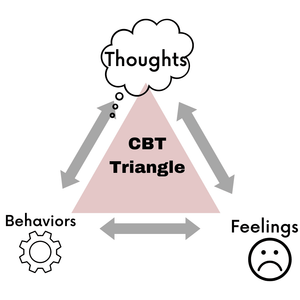
CBT, or Cognitive Behavioral Therapy, is a type of therapy that looks at how your thoughts, feelings, and behaviors affect each other. For example, challenging an anxious thought can reduce anxiety and help you respond differently.
Quiz
Books


Blog Posts
- Top 10 Practical CBT Exercises For Anxiety Relief
- Inner Critic vs Inner Coach (+10 Techniques To Stop Self-Critical Thoughts)
- What Causes Cognitive Distortions? (+Top 10 Common Cognitive Distortions & How To Challenge Them)
- 15 Cognitive Distortions (and How to Challenge Them)
- Top 12 Examples of Negative Self-Talk
- How to Break the Cycle of Hopeless Thinking?
CBT Journal Prompts
1. Identify a negative thought you frequently have about yourself. Challenge it by asking: Is there evidence to support this thought? What alternative, more balanced perspective can I adopt?
2. Write about a recent situation that triggered strong emotions in you. What thoughts accompanied those emotions? How could you reframe those thoughts in a more helpful, realistic way?
3. Reflect on a time when you made a mistake or experienced failure. How did you interpret it? What would be a more constructive and compassionate way to view that experience?
4. List three things you appreciate about yourself and explain why they are meaningful to you.
5. Write about a fear or anxiety that has been holding you back. What evidence supports this fear, and what evidence contradicts it? What steps can you take to challenge this fear?
CBT Apps
- MindShift CBT
Click here
A free CBT-based app with a thought journal, fear ladder, coping tools, daily check-ins, and exercises that encourage facing fears instead of continuing to avoid them.
CBT Podcasts
- Feeling Good Podcast — David Burns, MD
Click here
One of the most directly useful podcasts for CBT and negative thinking. Psychiatrist David Burns covers cognitive distortions, depression, anxiety, self-esteem, relationship problems, and practical methods for challenging thoughts.
TED Talks About Negative Thoughts and CBT
- What’s Your Frame? — Jennifer Willis
Click here
Directly explains the CBT link between thoughts, feelings, and behaviors and shows how cognitive reframing can change how you respond to situations. - Do You Talk to Yourself? Here’s How to Harness Your Inner Voice — Ethan Kross
Click here
Psychologist Ethan Kross explains how negative thought loops can keep you stuck and gives practical ways to change how you talk to yourself. - A Simple Trick to Improve Positive Thinking — Alison Ledgerwood
Click here
Looks at why negative information tends to stick more strongly than positive information and how deliberately reframing situations can shift your thinking. - No More Negative Thinking: From Seeds of Doubt to Seeds of Growth — Annabelle Lei
Click here
Focuses on recognizing negative thinking, reframing thoughts, changing behavior, and stopping repeated thought patterns from controlling your choices. - Don’t Believe Everything You Think — Lisa Penney
Click here
A useful reminder of a basic CBT principle: thoughts are interpretations, not automatically facts. It encourages questioning your assumptions before reacting to them. - How Our Thinking Impacts Our Behavior — Amalya Yeghoyan
Click here
Explores how thought patterns influence behavior and how changing negative thinking can change what you do next. - The Secret to Changing Negative Self-Talk by Renewing Your Mindset — Bruce Pulver
Click here
Focuses on recognizing repeated negative self-talk and deliberately changing the words and beliefs you use about yourself. - Rewriting Your Negative Self-Talk Script — Dan and Eisley Brandt
Click here
Shows how repeated negative internal messages affect mood and behavior and how those messages can be redirected. - Cognitive Bias: Why You’re Rightfully Wrong — Yaqine Saada
Click here
Explains cognitive biases and why your first interpretation of a situation may feel convincing even when it is inaccurate.